Summary
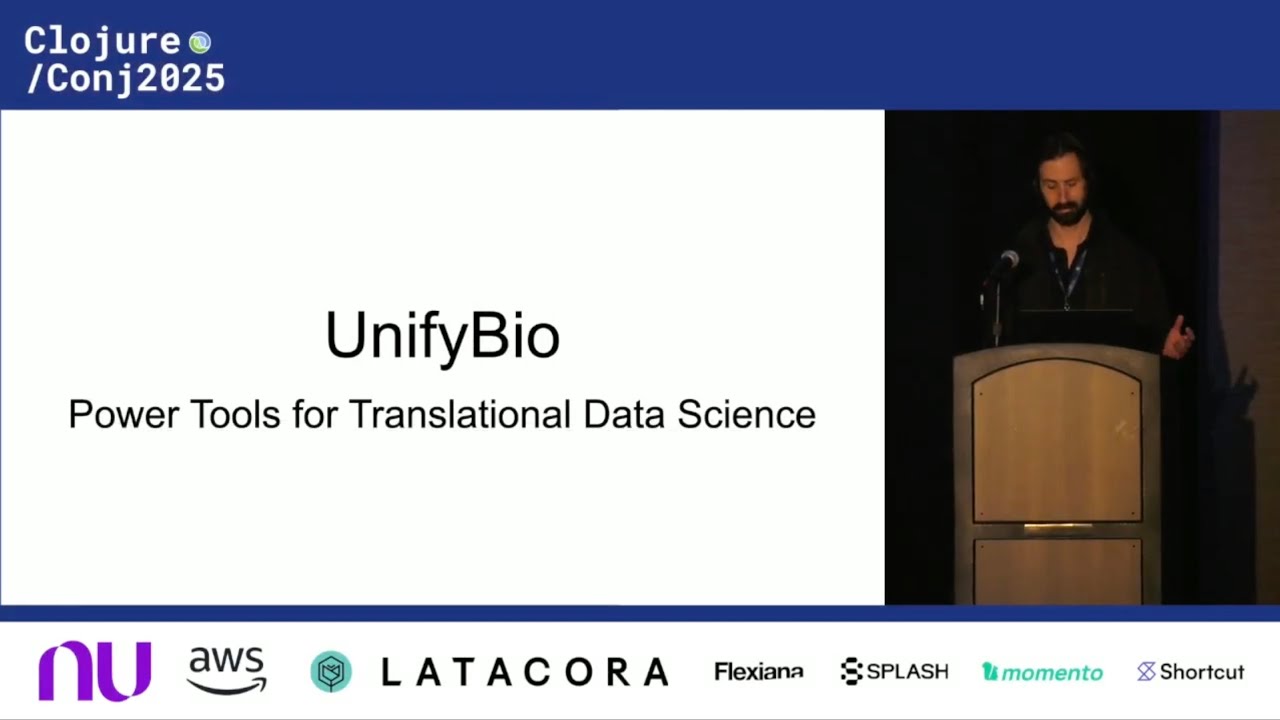
Benjamin Kamphaus, Technical Fellow at the Rare Cancer Research Foundation (RCRF), presents UnifyBio as a suite of power tools built on Datomic to overcome data silos in translational research. These tools facilitate data harmonization, ETL processes, and scalable access, enabling the integration of clinical and molecular datasets from disparate sources into unified representations within RCRF's Pattern Data Commons. This approach has revealed interconnections in rare cancer data that were previously invisible, fostering novel investigative paths. Drawing parallels from historical linguistics, Kamphaus argues that constraint satisfaction—reasoning from accurate facts and linguistic reconstructions—outperforms overly complex statistical models, as exemplified by archaeologist David Anthony's accurate mapping of Proto-Indo-European language spread without genetic data. Applying this to biology, he advocates treating cancer as an evolutionary tree derived from somatic mutations in individual patients (N=1 analysis), rather than relying solely on large cohort statistics. For rare cancers, which collectively affect a substantial portion of diagnoses but lack robust statistical power, this mindset shift allows personalized insights without traditional pipelines. Kamphaus shares his experience with Crohn's disease to highlight diagnostic challenges in rare conditions, mirroring founder Mark Labrecque's struggle with uveal melanoma. By prioritizing big-picture thinking over rote pipeline configuration, UnifyBio empowers researchers to ask unconstrained questions, potentially transforming rare cancer understanding and treatment.
Key Takeaways
- 1UnifyBio dismantles data silos in translational research by harmonizing clinical and molecular datasets using Datomic.
- 2Constraint satisfaction in data analysis outperforms flawed statistical models, as shown in historical linguistics and archaeology.
- 3Cancer can be modeled as an evolutionary tree from somatic mutations, enabling N=1 patient-specific analysis.
- 4Rare cancers, though individually uncommon, represent a significant portion of new diagnoses but challenge cohort-based research.
- 5RCRF's Pattern Data Commons integrates patient-contributed data to uncover hidden interconnections in rare cancer puzzles.
- 6Traditional bioinformatics pipelines involve complex, opaque graphs of legacy code, limiting holistic understanding.
- 7Shifting from recipe-following to imaginative, constraint-based approaches fosters innovation in computational biology.
- 8Ancient DNA and genetics later confirmed Anthony's horse-and-wheel migration theory for Indo-European languages.